Blog
How to Plan an Outdoor Kitchen Layout for a Small Australian Backyard

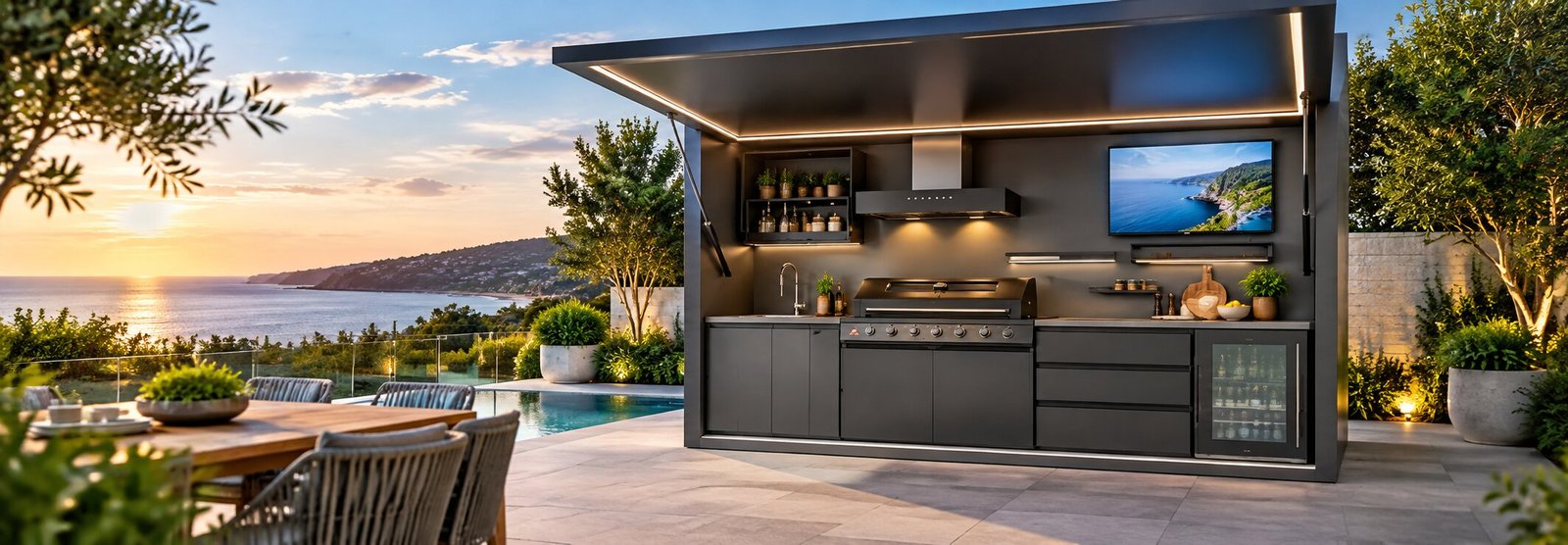
A good outdoor kitchen layout for a small backyard puts everything you cook with in one compact run, leaves clear room to move, and sits where gas, power, water and drainage can reach it. In most small Australian yards, a straight single-wall layout or a self-contained BBQ pod works best because it hugs a fence or wall, leaving the rest of the space free. This guide shows you how to measure your space, compare layouts, choose appliances and materials, and plan services, storage and seating.
Why Proper Outdoor Kitchen Planning Matters for Small Backyards
Planning matters more in a small backyard because every centimetre has a job. A poorly placed kitchen can block paths, crowd the dining area, push smoke towards the house or end up too far from the services it needs. A planned layout keeps cooking, prep and eating areas working together without taking over the yard.
Good planning helps you:
- Keep walkways clear to the back door, side gate, clothesline and lawn.
- Avoid costly changes to gas, power, water and drainage after installation.
- Control smoke and heat by placing the grill away from windows, doors and neighbours.
- Fit the right size unit rather than buying a kitchen the space cannot hold.
- Leave room for people, so the kitchen becomes a place to gather, not a bottleneck.
For layout ideas across different yard sizes and budgets, see our guide to backyard design ideas in Australia.
How to Measure and Assess Your Available Outdoor Space
Measure the full width, depth and height of the area you want to use, then subtract the space needed to walk past, open drawers and doors, stand at the grill and get the unit in during delivery. Mark the footprint on the ground with tape or chalk and live with it for a few days before you buy.
Step-by-step measuring checklist:
- Measure the area: width along the wall or fence, depth into the yard, and any overhead height limits, such as eaves, pergola beams, or a patio roof.
- Mark the footprint: use masking tape or chalk to outline the unit, including drawer and door swing.
- Check walkways: walk around the marked area carrying a tray. If you need to turn sideways, the layout is too tight.
- Find the services: note where your power points, taps, drainage and gas supply sit now.
- Check the base: the unit needs a level, load-bearing surface, such as a concrete slab or suitable paving.
- Check delivery access: measure gates, side paths and any steps the unit must pass through.
- Note the sun, wind, and neighbours: watch where the afternoon sun falls and which way the smoke will drift.
Example: our Diablo Mini outdoor BBQ pod measures 2200mm wide, 720mm deep and 2300mm high. On a courtyard fence line, you would mark a 2.2m by 0.72m rectangle, then add the space in front where you stand, open drawers and pass behind the cook.
Our step-by-step guide to setting up an outdoor kitchen pod at home covers site preparation in more detail.
Best Outdoor Kitchen Layouts for Small Australian Backyards
The best outdoor kitchen layout for a small Australian backyard is usually a straight single-wall run or a self-contained pod placed against a fence or house wall. L-shaped layouts suit corners with a little more depth, while galley and island layouts generally need more room than a compact yard can spare.
| Layout | How it works | Best for | Space needed | Watch out for |
| Straight (single-wall) | Grill, prep and storage in one line | Narrow yards, courtyards, side fences | Least depth | Limited bench space if too short |
| Self-contained pod | All-in-one unit with grill, sink and storage | Small yards wanting a finished look fast | Fixed footprint | Needs level base, services and delivery access |
| L-shape | Two runs meeting at a corner | Corners of patios or decks | More than a straight run | Corner storage can be awkward |
| Galley | Two parallel runs with a walkway between | Long, narrow spaces | Two runs plus walkway | Walkway can feel tight |
| Island | Freestanding bench with access from all sides | Larger yards and open patios | Most space | Usually too big for compact yards |
Practical examples:
- Townhouse courtyard: a straight-run pod along the back fence, with a small dining table opposite. The lawn or paving in the middle stays open.
- Narrow side yard: a slim single-wall layout under the eaves, keeping the side path clear for bins and access.
- Patio corner: an L-shape with the grill on one run and a sink and prep bench on the other, so the cook faces guests.
- Small deck: a compact pod, but only if the deck is built to carry the load.
A modular approach can help in a small yard. Our guide to modular outdoor kitchens explains how flexible designs fit different spaces.
Choosing Space-Saving Appliances and Essential Outdoor Kitchen Features
In a small outdoor kitchen, choose a grill sized to how many people you cook for, then add only the features you will use every week, such as a sink, a fridge space and good drawer storage. Built-in, all-in-one units save more space than separate freestanding appliances.
Essential features for most small kitchens:
- Grill or BBQ: the centre of the kitchen. Size it to your usual crowd, not your biggest party.
- Prep bench: leave space on either side of the grill for plates, tongs, and trays.
- Sink: saves trips inside, but needs a water supply and drainage.
- Fridge or fridge space: keeps drinks and food close.
- Drawers and cupboards: for utensils, covers and cleaning gear.
- Lighting: for evening cooking.
Optional extras if space allows: a rangehood, a pizza oven, a TV or a larger fridge.
How two pod sizes compare:
| Feature | Diablo Mini | Diablo 3.5m |
| Size | 2200mm W x 720mm D x 2300mm H | See product page for full dimensions |
| Grill | 32-inch built-in grill | 6-burner AGA-certified BBQ |
| Fridge | Space for your own fridge | 108L fridge included |
| Extras | Stainless sink with pull-out tap, Blum drawers, 24V LED lighting, electric gate with remote | Rangehood, 46-inch TV, 304 stainless cabinets, SAA-approved electrics |
| Best fit | Courtyards and compact yards | Yards with room for a longer run |
See the full specifications for the Diablo outdoor kitchen pod before you measure for the larger model. If pizza night is a priority, you can add a freestanding unit from our pizza ovens range rather than building one in.
Selecting Durable and Weather-Resistant Materials for Outdoor Kitchens
Choose materials that handle sun, rain, heat and, near the coast, salt air. Stainless steel and powder-coated galvanised steel are common choices for outdoor kitchens because they resist corrosion and are easy to wipe down. Cabinetry, benchtops and hardware should all be rated for outdoor use.
| Material | Strengths | Things to know |
| 304 stainless steel | Resists rust, easy to clean | Wipe down regularly, especially near the coast |
| Powder-coated galvanised steel | Tough, coloured finish | Touch up chips to protect the steel underneath |
| Stone or compact benchtops | Heat-resistant prep surface | Check outdoor and UV suitability |
| Outdoor-rated drawers and hinges | Smooth use in all weather | Keep tracks free of grit |
| LED lighting rated for outdoors | Low power, long-lasting | Must be installed to suit outdoor conditions |
Our Diablo 3.5m pod uses 304 stainless steel cabinets, with an exterior in black powder-coated galvanised steel or stainless steel. The Diablo Mini has a stainless enclosure. A fitted cover or a roof over the kitchen will help any material last longer.
Planning Ventilation, Plumbing, Electrical and Safety Requirements
Plan services before you choose a spot. An outdoor kitchen usually needs power, water and drainage for a sink, and a gas supply or cylinder for the grill. Gas, water, drainage, and electrical connections must be completed by licensed tradespeople, and the grill needs open airflow so that smoke and fumes can clear.
Services checklist:
- [ ] Power supply suited to outdoor use, connected by a licensed electrician.
- [ ] Water supply and drainage for the sink, connected by a licensed plumber.
- [ ] Gas supply or LPG cylinder, connected by a licensed gasfitter.
- [ ] Level, load-bearing base.
- [ ] Clear airflow around and above the grill.
- [ ] Distance from windows, doors, fences and plants.
Gas and ventilation. Energy Safe Victoria’s guide to gas and LPG safety outdoors says to use LPG cylinders only in well-ventilated outdoor areas, never indoors, and warns that outdoor LPG appliances pose a risk of carbon monoxide poisoning. It also advises checking fittings with soapy water and never using a flame to find a leak.
Fire bans. On a Total Fire Ban day in NSW, the NSW RFS Total Fire Ban rules allow a gas barbecue only under conditions, including a responsible adult present at all times, no combustible material within two metres and an immediate supply of water. Solid-fuel barbecues and wood-fired pizza ovens cannot be used outside on those days. Other states have their own rules, so check with your local fire service.
Approvals. Rules differ between councils, so check with your local council before you order.
How to Maximise Storage, Seating and Functionality in a Small Outdoor Kitchen
Make the most of a small outdoor kitchen by storing vertically, using drawers rather than open shelves, and choosing seating that tucks away or doubles as storage. Keep the cook’s zone clear, and place seating so guests can talk to the cook without standing in the way.
Storage ideas:
- Deep drawers for tongs, platters and trays.
- Wall hooks or rails above the bench for tools.
- Closed cupboards to keep gear dry and free of dust and insects.
- A dedicated bin spot so rubbish does not crowd the prep area.
Seating ideas:
- A compact table opposite the kitchen, leaving a clear path between.
- Bench seating along a fence, freeing up floor space.
- Bar stools at a bench overhang, if the layout allows guests to sit facing the cook.
Browse our outdoor dining tables for pieces sized to small spaces.
Workflow tip: set up your bench in the order you cook. Fridge, then prep space, then grill, then serving space. This keeps you from crossing back and forth with raw and cooked food.
Frequently Asked Questions
What is the best outdoor kitchen layout for a small backyard?
A straight single-wall layout or a self-contained BBQ pod is usually best for a small backyard. Both sit against a fence or wall, keep the cooking zone compact and leave the rest of the yard open. An L-shape can work in a corner with a little more depth.
How much space do you need for an outdoor kitchen?
You need room for the unit itself plus space to stand, open drawers, and walk past. For example, the Diablo Mini pod measures 2200mm wide and 720mm deep. Mark the footprint on the ground and test the walkways before you buy.
How much does a small outdoor kitchen cost in Australia?
It depends on size, features and installation. As a guide, our Diablo Mini pod is $16,999 including GST, and the Diablo 3.5m pod starts from $19,999 including GST, with delivery extra. Trade connections and base preparation are additional.
Do you need council approval for an outdoor kitchen in Australia?
It depends on your council, your property and the type of work involved. Rules vary across Australia, so check with your local council before you order. Gas, plumbing and electrical work must also be done by licensed tradespeople.
Can you install an outdoor kitchen on a covered patio or under a pergola?
Often, yes, as long as the area is well ventilated and the appliance’s clearance requirements are met. Gas appliances should never be used in enclosed spaces due to the risk of carbon monoxide. Check the manufacturer’s instructions and ask your gasfitter about your setup.
Plan Your Outdoor Kitchen Layout With Confidence
The right outdoor kitchen layout for a small Australian backyard starts with careful measuring, a compact design, and planned services before you buy. Choose features you will use often, pick weather-resistant materials and leave clear room to move and gather.
Want to learn more first? Read our guide to outdoor BBQ pods in Australia, or contact us to talk through your space.