
Blog
Outdoor BBQ Pods: What They Are & Why They’re Taking Over Australian Backyards

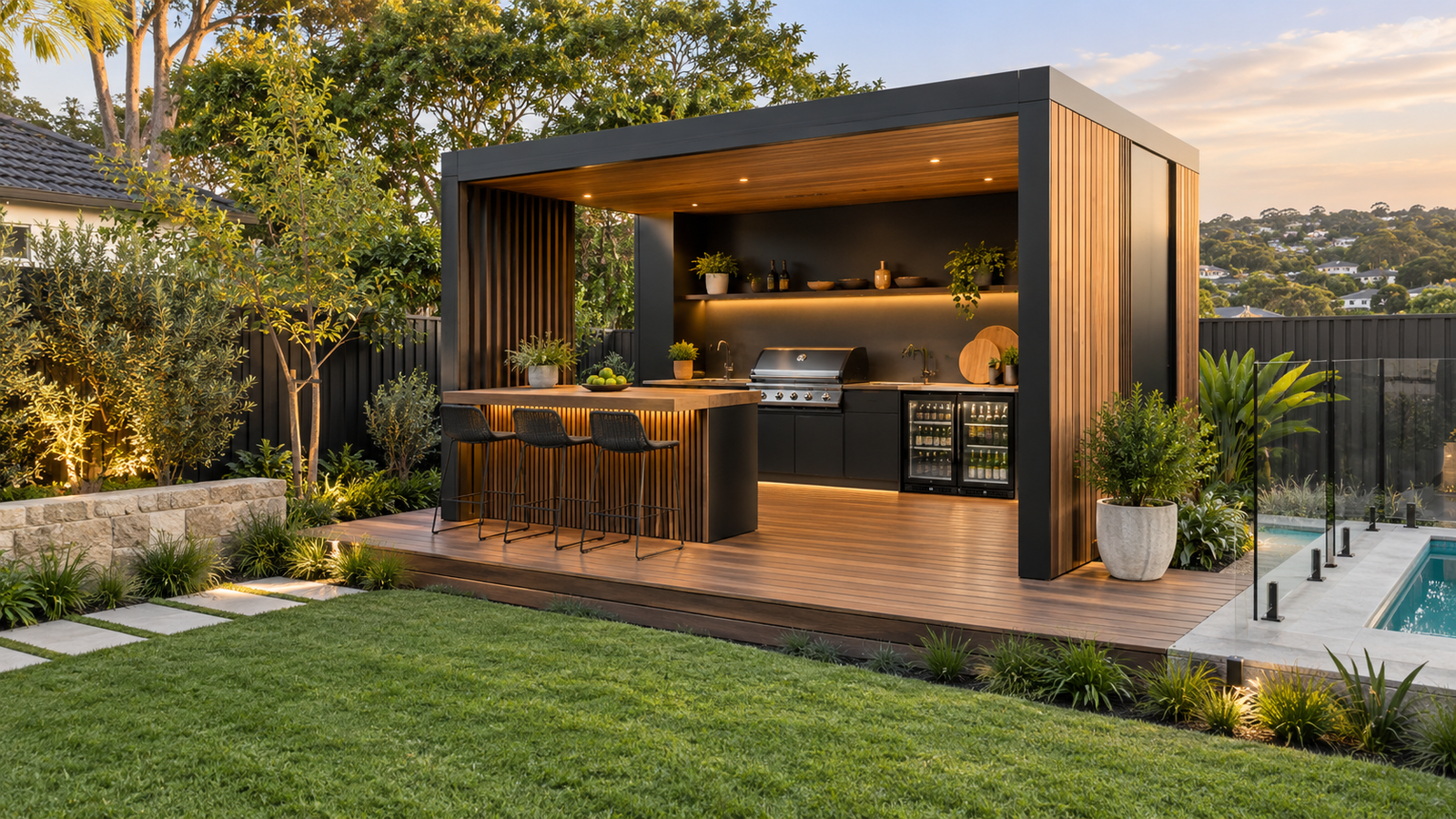
An outdoor BBQ pod is a compact or modular cooking station that combines a barbecue, work surfaces, storage, and optional appliances into a coordinated unit. BBQ pods Australia-wide have become a popular alfresco addition because they turn what used to be a multi-trade building project into a single, defined package. Some models close up when not in use, protecting the barbecue and any fridge, sink or television inside. Others stay open, working more like a compact freestanding kitchen. Inclusions vary widely too, from basic barbecue cabinetry through to units with sinks, refrigerators, rangehoods, lighting, and built-in entertainment features. This guide covers what a BBQ pod is, its benefits and trade-offs, what pods cost in Australia, the features to check before you buy, and how they hold up to Australian weather and council rules. A BBQ pod is a prefabricated or modular outdoor kitchen unit designed to combine cooking, preparation and storage functions within a compact structure.
What Are BBQ Pods in Australia and How Do They Work?
BBQ pods in Australia are modular outdoor cooking units that combine several kitchen functions within a freestanding or installed structure. Depending on the model, the unit may open for use and close to protect its internal components when you’re done. The general process looks like this:
- The pod is delivered as a complete or partly assembled unit.
- It is positioned on a suitable prepared surface.
- Required electrical, gas, water or waste services are assessed.
- Licensed trades connect any regulated services where necessary.
- Doors, panels or canopies open to create the cooking zone.
- Appliances and preparation areas operate as one coordinated setup.
- The unit is cleaned and closed or covered after use, where its design allows.
| Component | Purpose | Is it included? | What to check |
|---|---|---|---|
| Barbecue | Main cooking appliance | Commonly | Fuel type, certification, size and clearance requirements |
| Benchtop | Preparation and serving | Commonly | Material, heat resistance and maintenance |
| Cabinetry | Storage and appliance support | Commonly | Material, seals and corrosion resistance |
| Sink and tap | Food preparation and cleaning | Optional | Water supply and wastewater connection |
| Refrigerator | Cold storage | Optional | Outdoor suitability, ventilation and power |
| Rangehood | Captures cooking fumes and heat | Optional | Discharge, clearance and installation requirements |
| Lighting | Illuminates the work area | Optional | Electrical rating and control |
| Television | Entertainment | Optional | Outdoor suitability and viewing position |
| Enclosure panels | Protect components when closed | Product dependent | Wind limits, seals and operating method |
| Adjustable supports | Level the unit | Product dependent | Surface and structural requirements |
“Plug and play” doesn’t mean “no site assessment required”. Plumbing, gas, ventilation, stability and electrical supply may all still need professional review before a pod is connected and switched on.
How Is a BBQ Pod Different From a Standard Outdoor Kitchen?
A BBQ pod is generally supplied as a coordinated modular unit, while a conventional outdoor kitchen is usually designed and built around a specific site.
| Comparison point | BBQ pod | Conventional outdoor kitchen |
|---|---|---|
| Design | Preconfigured or modular | Site-specific and highly customisable |
| Construction | Mainly completed before delivery | Built or assembled at the property |
| Installation period | May be shorter once the site is ready | Often involves several trades and stages |
| Customisation | Limited to available options | Broad choice of layout and materials |
| Relocation | Product and service dependent | Usually permanent |
| Enclosure | Available on selected models | Normally needs separate covers or structures |
| Site integration | Added to an existing area | Can be built into walls, patios and landscaping |
| Services | Predetermined connection locations | Can be routed to suit the design |
| Delivery access | Whole or large modules need clear access | Materials can often be brought in separately |
| Price certainty | Package pricing may simplify comparison | Final price depends heavily on design and trades |
| Expansion | Limited by the pod system | It may be easier to extend through custom work |
| Approval | Site and connection dependent | Site, structure and services dependent |
Neither format is universally better. A pod may suit buyers who want a coordinated package with less design decision-making, while a custom outdoor kitchen may suit unusual spaces or highly specific requirements. Our guide to modular outdoor kitchens looks at this trade-off in more detail.
What Are the Benefits of Installing a BBQ Pod in Your Backyard?
A BBQ pod can simplify outdoor kitchen planning by grouping compatible cooking, storage, and entertainment features into a single defined unit. Its value depends on whether the dimensions, inclusions and service requirements actually suit your property. Potential benefits:
- Coordinated design and a defined package of appliances and cabinetry
- Compact use of space
- Potentially shorter site-installation period
- Consistent finishes
- Enclosable design on selected models
- Integrated storage
- Less need to design every component separately
- A clear outdoor entertaining focal point
Limitations:
- Fixed dimensions and restricted appliance choices
- Delivery access requirements
- Limited customisation
- High upfront price
- Connection costs
- Difficulty replacing integrated components
- Need for a suitable slab or surface
- Possible approval requirements
- Exposure to salt, wind and weather, depending on the site
| Homeowner requirement | BBQ pod suitability | Reason |
|---|---|---|
| Coordinated all-in-one setup | High | Main components may already be packaged together |
| Highly unusual patio shape | Low to medium | Fixed pod dimensions may not fit |
| Fast installation after preparation | Potentially high | Much of the unit may arrive assembled |
| Full control over every material | Lower | Options depend on the manufacturer |
| Ability to close the kitchen | Product dependent | Selected pods include enclosure panels |
| Narrow side access | Potentially low | Delivery dimensions may be restrictive |
| Future relocation | Product dependent | Connections and weight may limit movement |
| Premium entertaining feature | High | Creates a defined cooking and social zone |
How Much Do BBQ Pods Cost in Australia?
BBQ pod prices in Australia vary by size, materials, appliances, enclosure design, and included services. Delivery, site preparation and trade connections are commonly charged separately from the product price. As a current example, Outdoor Living HQ’s range of outdoor kitchen pods lists two verified models at the time of writing (September 2026): a compact pod and a large, fully equipped pod. Prices, stock position and inclusions can change, so treat these as a guide and confirm the current listing before budgeting.
| BBQ pod type | Typical product price | Delivery | Installation and connections |
|---|---|---|---|
| Compact pod, e.g. Diablo Mini Outdoor Kitchen Pod | $16,999, GST included (currently a promotional price, reduced from $20,999) | Calculated on application | Site and connection dependent |
| Large fully equipped pod, e.g. Diablo 3.5m Outdoor Kitchen Pod | From $19,999, GST included | Price on application | Site and connection dependent |
| Customised or larger configuration | Quote required | Quote required | Quote required |
Costs that often sit outside the advertised product price include:
- Freight, crane, forklift or lifting equipment for restricted-access delivery
- Concrete slab, foundation, deck reinforcement or levelling
- Electrical circuit or outlet installation
- Gas connection or LPG setup
- Plumbing, wastewater connection and drainage
- Rangehood ducting
- Pergola or roof changes
- Council or certifier fees, or strata approval
- Appliance upgrades and protective covers
- Site restoration or removal of existing outdoor cabinetry
Treat every figure above as indicative. A complete quote requires your delivery postcode, access details, the selected model, and site requirements.
What Should a BBQ Pod Quote Include?
A proper quote should identify:
- Pod model and dimensions
- Cabinet and exterior materials
- Appliances, including product certifications
- Benchtop, sink and tap
- Refrigerator, rangehood and lighting
- Television or entertainment equipment
- Doors, enclosure panels and accessories
- GST, freight and unloading method
- Site placement and assembly
- Gas, electrical and plumbing exclusions
- Warranty for the pod and separate appliance warranties
- Lead time, customisation costs, and cancellation or variation terms
Compare the total installed cost across quotes, not just the advertised pod price. Two similarly priced pods can end up with very different total costs once delivery, connections, and site work are added.
What Features Should You Look for in an Outdoor BBQ Pod?
Look for durable materials, compatible appliances, practical ventilation, accessible services, and a layout that provides enough space for preparation, cooking, and storage for how you actually entertain. Work through these features before comparing models:
- Overall dimensions and cooking-surface size
- Burner configuration and appliance certification
- Benchtop space and heat-resistant materials
- Cabinet construction and corrosion protection
- Outdoor-rated refrigerator
- Sink and drainage
- Rangehood
- Task lighting and power outlets
- Storage and waste-bin space
- Doors, seals and locking points
- Adjustable feet and drainage paths
- Service access and replacement-part availability
- Product and appliance warranties
| Feature | Why it matters | Question to ask |
|---|---|---|
| Cabinet material | Affects durability and maintenance | Which grade and finish are used? |
| Barbecue | Determines cooking capacity and fuel requirements | Is it certified and included in the price? |
| Rangehood | May manage heat and cooking fumes | Where does it discharge? |
| Refrigerator | Provides outdoor cold storage | Is it rated for the intended outdoor setting? |
| Sink | Supports preparation and cleaning | How are water and waste connected? |
| Electrical system | Supplies lights, fridge, TV and other appliances | What supplies and protection are required? |
| Enclosure | Protects internal components when not in use | What exposure and wind conditions is it rated for? |
| Service access | Allows maintenance and replacement | Can appliances and connections be reached easily? |
| Warranty | Defines repair and replacement support | Are pod and appliance warranties separate? |
| Spare parts | Affects long-term repairability | Are hinges, seals and panels replaceable? |
What Size BBQ Pod Will Fit Your Outdoor Area?
The product dimensions in a listing don’t show how much space the pod actually needs while in use. Before ordering, measure:
- Overall closed width, depth and height, plus open width and depth
- Door and canopy swing
- Barbecue and rangehood operating clearances
- Space for users to stand and circulate behind stools or seating
- Distance from combustible materials, doors and windows
- Ceiling or pergola height
- Delivery route width and height, gate openings, steps and turning space
- Slab or deck capacity
- Gas-cylinder position, where applicable
- Access for maintenance
Mark out the closed and open footprint on the ground with tape or string before you order, not just the boxed dimensions on the spec sheet.
Are BBQ Pods Suitable for Australian Weather and Outdoor Entertaining?
BBQ pods can suit Australian outdoor entertaining when their materials, appliances and enclosure are appropriate for the site. Suitability depends on sun, rain, salt, wind, drainage and how sheltered the location is, not on the product being labelled “outdoor”.
| Site condition | Potential issue | What to check |
|---|---|---|
| Direct summer sun | Heat, fading and hot surfaces | UV exposure, shading and appliance limits |
| Heavy rain | Water entry and pooling | Roof design, seals, drainage and site falls |
| Strong wind | Moving panels or unsafe operation | Wind limits and closing procedures |
| Coastal air | Accelerated corrosion | Material grade, coating and maintenance |
| High humidity | Condensation and corrosion | Ventilation and cleaning requirements |
| Frost or cold climate | Appliance and plumbing exposure | Manufacturer instructions and winter care |
| Bushfire-prone location | Combustible materials and local controls | Planning and bushfire protection requirements |
| Covered alfresco area | Possible gas and ventilation concerns | Appliance instructions and enclosure classification |
Placement checklist:
- Suitable level base and safe cooking clearances
- Adequate ventilation and protection from prevailing weather
- Drainage away from the unit, with space to open panels
- Accessible isolation points and a safe gas-cylinder location
- Weather-appropriate electrical equipment
- No obstruction of exits, and a suitable distance from boundaries
- Accessible maintenance routes
- Compliance with any pergola or alfresco restrictions
A closed or partly enclosed alfresco area can change ventilation requirements. Don’t assume an appliance approved for general outdoor use can operate safely in every covered space; check the manufacturer’s instructions for the specific enclosure. If your property is on land identified as bushfire-prone, the NSW Rural Fire Service explains how a property’s Bush Fire Attack Level shapes construction requirements, and equivalent rules apply through your local fire authority in other states.
What Should You Check Before Buying a BBQ Pod?
Work through this checklist alongside your site assessment:
- Available space, open and closed dimensions, and delivery access
- Foundation or slab
- Cooking capacity and fuel preference
- Gas connection and electrical demand
- Water and waste connections
- Ventilation and weather exposure
- Material suitability and appliance specifications
- Product certification
- Cleaning access, replacement parts and warranty
- Lead time, delivery cost and installation cost
- Council, building or strata requirements
| Buyer’s priority | The BBQ pod may suit when | A standard outdoor kitchen may suit when |
|---|---|---|
| Faster design process | A suitable preconfigured package is available | Extensive custom planning is acceptable |
| Custom layout | Available pod options match the space | The site needs a unique footprint |
| Enclosed appearance | The selected pod can close when not used | Separate covers or permanent cabinetry are preferred |
| Appliance choice | Included products meet requirements | Specific brands and models are required |
| Difficult access | The pod can be delivered safely | Materials need to be carried in separately |
| Future changes | Modular options support them | A permanent integrated design is preferred |
| Budget certainty | Inclusions and exclusions are clearly priced | Custom trade quotes can be coordinated |
Any gas connection needs a licensed gasfitter. Energy Safe Victoria confirms that gas fitting work should only be carried out by a licensed gasfitter, who issues a compliance certificate on completion, and equivalent licensing applies in every state. The same principle applies to electrical work: Energy Safe Victoria requires electrical installation work to be carried out by a licensed electrician or registered electrical contractor. Where a sink or wastewater connection is involved, Victoria’s plumbing regulator advises engaging a licensed or registered plumber for any plumbing work, a rule mirrored by plumbing licensing bodies across other states. Council approval requirements depend on the pod’s size, permanence, services and your specific property and zone. Some minor freestanding structures may fall under an exempt development pathway in NSW, but gas lines, new electrical circuits, plumbing and any roofed structure can change that assessment. Strata properties may also require approval from the owners’ corporation. Always confirm with your local council or certifier before ordering, rather than assuming a pod is automatically exempt. Our step-by-step guide to setting up an outdoor kitchen pod covers the planning process in more depth. Get a site assessment and a complete installed-cost estimate before placing an order, rather than deciding on product price alone.
Get a Free Quote for Your Outdoor BBQ Pod
BBQ pods in Australia offer a coordinated alternative to designing a conventional outdoor kitchen from individual components, trading some customisation for a defined, packaged setup. The right BBQ pod for Australian homeowners should fit the available space, cooking habits, delivery access, weather exposure, and service requirements, not just the advertised price. Compare the complete installed cost, including delivery, connections and any approvals, rather than the product price alone. A tailored recommendation should account for your available space, delivery access, preferred appliances, weather exposure and service connections. Get in touch for advice suited to your backyard, or browse the current outdoor kitchen pod range to compare models.
Frequently Asked Questions
What is a BBQ pod?
A BBQ pod is a compact, prefabricated or modular outdoor kitchen that combines a barbecue with preparation, storage, and optional appliance features in a single structure. Configurations vary between manufacturers, and some products include closing panels or a canopy that protects the internal components when the pod isn’t in use. Others stay open like a compact freestanding kitchen.
How much do BBQ pods cost in Australia?
Verified pricing at Outdoor Living HQ currently starts around $16,999 GST included for a compact pod and from $19,999 GST included for a large, fully equipped model, with delivery priced on application. Freight, site preparation, gas, electricity, plumbing and any approvals can add to the installed cost. Always get a complete written quote rather than budgeting from the advertised product price alone.
Are BBQ pods suitable for Australian backyards?
They can suit Australian backyards when the dimensions, materials, weather protection and services match the site. Coastal exposure, direct sun, wind, ventilation, drainage and delivery access all affect how well a specific pod performs once installed, so check these against the manufacturer’s ratings before buying rather than assuming every pod handles every climate the same way.
What can you include in an outdoor BBQ pod?
A pod may include a barbecue, benchtop, storage cabinetry, sink, refrigerator, rangehood, lighting and entertainment equipment such as a television. Features vary considerably by model, and each appliance needs to suit the proposed outdoor setting, including its exposure to weather and whether it sits inside an open or fully enclosed pod structure once installed.
Do BBQ pods require council approval in Australia?
Approval depends on the location, size, permanence, service connections, structural work, planning controls and property type. Gas, electrical and plumbing connections, and any roofed or enclosed structure, are more likely to trigger approval requirements than a simple freestanding unit. Always check with your local council or certifier, and confirm owners’ corporation approval if the property is part of a strata scheme.
image