Blog
Ethanol, Steel or Smokeless: Which Fire Pit Should You Buy?

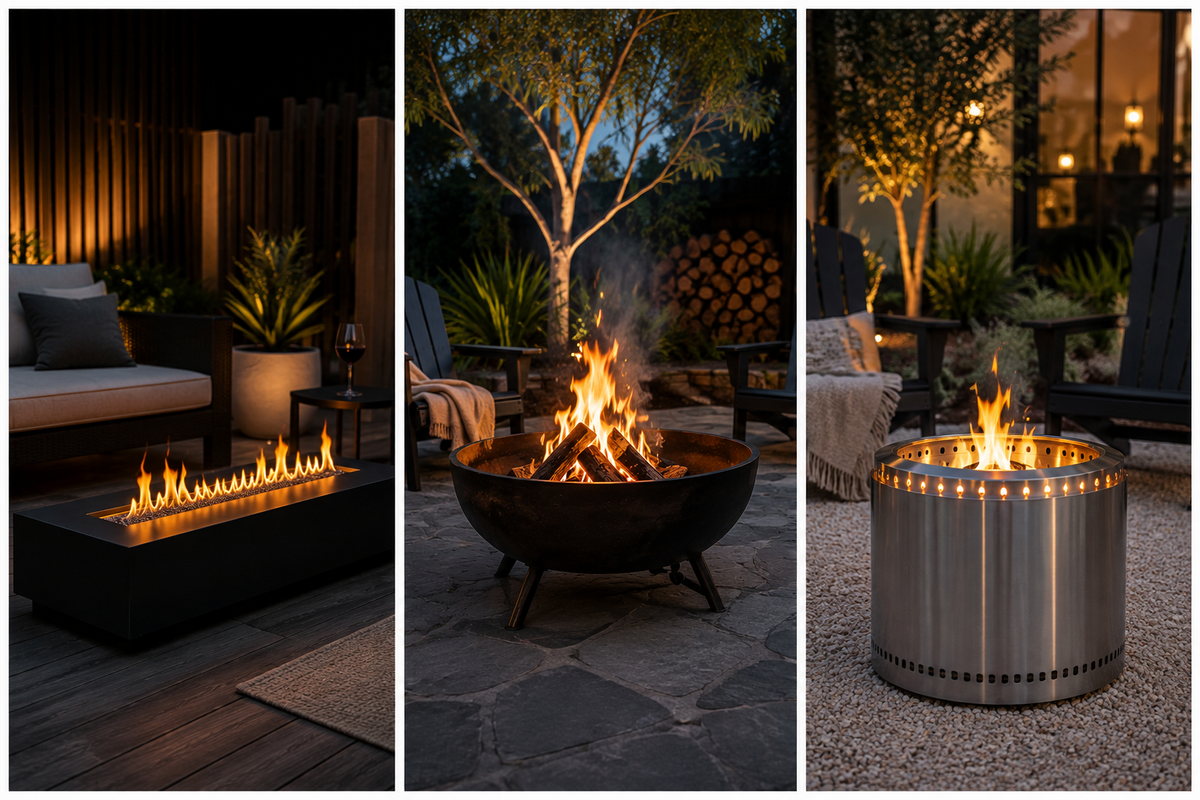
A fire pit changes how you use an outdoor space once the weather turns. The catch is that ethanol, steel and smokeless models behave very differently, and the one that suits a large backyard can be useless, or banned outright, on a small balcony. Here is how the three compare in terms of heat, smoke, cost, and upkeep, and which one fits the way you actually live.
Before You Add One to Cart
- Ethanol is the pick if you want a clean-looking flame, no wood to store and almost nothing to clean up afterwards. Accept that it warms the mood more than the people.
- Steel gives you the most heat for the money and a proper wood fire, but it requires firewood storage, ash removal, and rust management.
- Smokeless sits between the two. You still get a real wood fire, with noticeably less smoke drifting into your guests’ and your neighbour’s washing.
- Gas is a genuine fourth option, but it is a different purchase with different plumbing and refill considerations, and most Australian retailers treat it separately.
- None of this matters until you check what your council, strata or lease actually allows. A compact fire pit that physically fits on a balcony can still be prohibited.
In This Guide
- How ethanol, steel and smokeless fire pits compare
- The pros and cons of ethanol fire pits
- Why choose a traditional steel fire pit
- Are smokeless fire pits really smoke-free
- What about gas fire pits
- How to choose the best fire pit for your space
- What a fire pit costs to buy and run
- Maintenance and safety
- Frequently asked questions
How ethanol, steel and smokeless fire pits compare
The three types differ most in fuel, heat output, smoke, and the amount of upkeep they require. Ethanol, as a liquid, burns and produces a controlled, decorative flame. Steel burns seasoned firewood and throws real radiant heat, along with the sparks, ash, and smoke that come with an open wood fire. Smokeless models also burn wood or approved pellets, but a double-wall airflow design reburns much of the smoke before it escapes the chamber.
| Factor | Ethanol | Steel | Smokeless | Gas |
|---|---|---|---|---|
| Typical fuel | Bioethanol | Seasoned firewood | Dry firewood or approved pellets | LPG bottle or natural gas |
| Heat output | Low to moderate | High | Moderate to high | Moderate |
| Smoke | Minimal when used correctly | Moderate to heavy | Reduced, not eliminated | None |
| Ash and debris | Minimal | High | Moderate | None |
| Maintenance | Low | Moderate to high | Moderate | Low |
| Fire experience | Clean, decorative flame | Traditional open wood fire | Wood fire with less visible smoke | Consistent, controllable flame |
| Portability | Often highly portable | Depends on size and weight | Usually portable but can be heavy | Limited by bottle or gas line |
| Cooking | Not suitable | Yes, with a grill plate | Yes, with a compatible grill | Rarely |
| Best for | Ambience and compact spaces | Backyards and serious heat | Entertaining with less smoke | Patios and smoke-restricted areas |
| Main drawback | Lower heat, higher fuel cost per hour | Smoke, sparks, ash, and rust | Costs more than a basic steel bowl | Bottle refills and no crackle |
Treat the table as a starting point rather than a rule. Burner size, chamber design, wall thickness and fuel quality all shift where a specific product lands.
If you are mainly after atmosphere for a small courtyard or patio, ethanol is usually the best fit. If you want a fire that keeps a group of people warm on a cold night, steel is hard to beat. If you like wood fires but not the smell in your hair the next day, a smokeless design is worth the extra cost.
The pros and cons of ethanol fire pits
An ethanol fire pit burns liquid bioethanol rather than firewood, so there is no wood to store and no ash to shovel out the next morning. The flame sits above a burner insert, and most models are designed to be lit, enjoyed, and shut off without any fuss. Many of the larger units double as a low table, which is part of why they suit courtyards and balconies where floor space is tight.
Advantages
- Minimal smoke, soot and ash during correct operation
- Lights instantly, no kindling and no fire-starting skill required
- Almost nothing to clean between uses
- Contemporary look that suits modern outdoor settings
- No firewood storage or delivery to organise
- Compact and portable designs available
- Well suited to ambience-focused entertaining
Limitations
- Noticeably less heat than a wood-burning model of similar size
- Fuel costs more per hour than firewood
- Bioethanol needs careful handling and storage
- The flame can be hard to see in bright daylight
- Spilled fuel is a serious hazard
- The burner must never be refilled while lit or still hot
- Indoor suitability must never be assumed
- No cooking, and no crackle
It is worth separating flame quality from actual heating performance. An ethanol burner can look striking while producing far less warmth than a wood fire the same size, so if heat is the priority, check the manufacturer’s specifications rather than trusting the visual impression. Burner capacity also determines burn time, so a larger insert runs longer between refills.
These devices are covered in Australia by the Consumer Goods (Decorative Alcohol Fuelled Devices) Safety Standard 2017, and refuelling incidents are one of the most common causes of injury. The ACCC singles out tabletop burners as particularly dangerous for three reasons: the point where you pour in the fuel is also where the flame sits; the small fuel capacity leads to short burn times that tempt people to refill a hot burner; and the light units are easy to knock over. Confirm with the retailer that any model you are considering complies with the standard, and never assume an outdoor unit is approved for indoor use.
Why choose a traditional steel fire pit
A steel fire pit is the classic choice if you want strong radiant heat, tall visible flames and the atmosphere of a real wood fire. It suits anyone entertaining a group outdoors who wants the fire itself to be the centre of the evening. The category covers open bowls, square and rectangular pits, braziers, and partially enclosed chimineas that push heat forward rather than up.
Key benefits
- The strongest heat output of any of the three types
- A genuine wood-fire atmosphere, crackle included
- Simple construction with very little to go wrong
- The widest range of shapes, sizes and price points
- Doubles as a cooking surface with a grill plate or hotplate
- Good long-term value if you use it regularly
- Works for camping, subject to the site’s rules
The trade-off is everything that comes with burning wood in the open: smoke, sparks, ash and somewhere dry to keep the firewood.
What about rust?
No steel fire pit is genuinely rust-proof, but the material makes a real difference. Mild and carbon steel are the most affordable and the most prone to surface rust once left uncovered. Cast iron holds heat exceptionally well and lasts decades if kept dry, though it is heavy and will rust if neglected. Stainless steel resists corrosion best and is the sensible pick within a few kilometres of the coast. Corten, or weathering steel, forms a stable rust-coloured surface layer on purpose and is designed to be left outdoors, so choose it for the look rather than expecting a clean finish.
Thicker-gauge steel also resists warping better under sustained heat. Airflow matters just as much: a pit with restricted air intake burns less efficiently and smokes more, and dry seasoned firewood burns considerably cleaner than damp or green wood. Always set the pit on a stable, non-combustible surface, since sparks and radiant heat will damage decking and paving over repeated use.
Are smokeless fire pits really smoke-free?
No. A wood-burning fire pit is never completely smoke-free, no matter what the marketing says. Smokeless models reduce visible smoke through a double-wall airflow design and secondary combustion, in which smoke-producing gases and particles are burned a second time once the fire reaches its operating temperature.
That second burn only works properly once the fire is established. Smoke can still appear:
- During ignition, before the chamber heats up
- When you add fresh wood
- If the wood is damp, green or unseasoned
- If the vents are blocked by ash build-up
- If you overfill the chamber and choke off the airflow the design relies on
- In certain wind conditions
Reduced smoke also does not mean zero sparks, embers, ash or carbon monoxide. Wood smoke carries fine particles and gases that affect air quality, no matter how little you can see. CHOICE reports that in metropolitan Melbourne, 51% of the most dangerous form of air pollution, PM2.5, is caused by wood fires, and the NSW EPA’s wood smoke guidance explains why dry, well-seasoned fuel and good burning practice matter for your neighbours and for you, even with a well-designed appliance.
If you like the experience of a wood fire but not the smoke clinging to your guests and your outdoor furniture, a smokeless fire pit is worth the extra cost.
What about gas fire pits?
Gas and LPG fire pits are worth knowing about, even if they are not the right answer for most backyards. They light instantly, produce no smoke or ash, offer precise flame control and are often the only open-flame option permitted where wood smoke is restricted. Many are built into a table, which makes them popular on covered patios.
The catch is that they run on a gas bottle you need to refill or a fixed line you need installed; they produce less usable heat than a wood fire of the same size, and they cost more upfront for the same warmth. You also lose the crackle and the smell that most people buy a fire pit for in the first place.
If a gas unit is what you are after, it is a specialist purchase through a gas appliance retailer. If what you actually want is smoke control rather than gas specifically, a smokeless wood-burning model gets you most of the way there at a lower price and keeps the real fire.
How to choose the best fire pit for your space
The best type of fire pit depends as much on where it goes as on the product itself. A pit that works beautifully in a large backyard can be unsuitable or prohibited on a small balcony.
Buying checklist
- Measure the available space accurately
- Confirm the clearances your chosen product requires
- Check for overhead roofing, branches and awnings
- Plan for a stable, non-combustible surface
- Check council, strata, lease and fire-restriction requirements
- Decide whether heat or ambience matters more to you
- Consider how smoke will affect neighbours
- Check access to firewood, pellets or bioethanol in your area
- Assess portability and where it will be stored
- Read the manufacturer’s approved fuels and placement instructions
Recommendations by space
Balcony. Do not assume a fire pit is permitted just because it is small or portable. Check strata rules, building rules, lease conditions and fire-safety requirements before you buy anything with an open flame. Where open flames are not allowed at all, a compact ethanol unit is usually the only realistic option.
Small patio. A compact ethanol model or a correctly sized smokeless design works well, subject to clearances and your local rules. Think about the surrounding setup at the same time, since patio furniture that can handle nearby radiant heat will last considerably longer than furniture that cannot.
Courtyard. A smokeless model cuts visible smoke, which matters most in an enclosed space, but you still need real ventilation, safe clearances and a stable surface.
Large backyard. Steel or smokeless gives you stronger heat and a bigger flame, with more room to manage clearances and smoke drift.
Camping. Stick to products approved for the specific site and follow campground, park and fire-restriction rules. What is allowed at one site may be banned outright at another, particularly over summer.
Can you cook on it?
If cooking matters, this quickly narrows the field. Steel pits and most smokeless models accept a grill plate, hotplate or swing arm, and many are sold with the accessory or offer it separately. Ethanol fire pits are not designed for cooking and should never be used for it. If a fire pit is going to double as your outdoor cooking setup, check that a compatible grill exists for that exact model before you buy, not afterwards.
What a fire pit costs to buy and run
The purchase price is only part of it. Fuel, covers, cleaning gear, storage and weather exposure all add up.
Purchase price
Basic steel bowls from the large chains start at $75 to $180. Quality carbon steel fire pits generally sit between $400 and $600. Smokeless models range from roughly $140 for entry-level units to $700 or more for premium double-wall designs. Cast iron and designer Corten pieces run from around $300 up to $1,000. Ethanol fire pit tables are the most expensive category, typically $1,200 and up, because you are buying both furniture and a burner. Grill plates and accessories typically add $70 to $100.
Running costs
Firewood is the cheapest fuel by a wide margin. Split hardwood delivered runs roughly $190 to $400 per cubic metre, depending on the species, and small bags for occasional use cost around $13 to $50. Bioethanol costs considerably more: buying in 20-litre volumes works out to about $5 per litre, and a typical burner uses roughly half a litre to a litre an hour, so a long evening can cost more in fuel than a whole bag of firewood.
That said, the cheapest fuel does not mean the cheapest to own. Firewood needs to be stored in a dry place, and the delivery requires you to be home. Bioethanol arrives in a container that sits on a shelf. Factor in how often you will realistically light it, because a fire pit used twice in winter has very different economics from one used every weekend.
Maintenance and safety
Wood-burning models need regular ash removal, and smokeless designs need their vents kept clear so the airflow system continues to work. Clean ethanol burners according to the manufacturer’s instructions. Across all types, clear away leaves and moisture, check steel components for corrosion, fit a cover only once the unit is completely cool, store portable models in a protected place, and check for damage before every use.
Safety essentials
- Follow the manufacturer’s instructions for your specific product
- Keep clearances from structures, fences and overhanging vegetation. Three metres is the commonly cited minimum
- Use a stable, non-combustible surface
- Keep children and pets well away
- Never leave an active fire unattended
- Keep suitable fire-control equipment within reach
- Never use petrol or any unapproved accelerant
- Never refill an ethanol burner while it is lit or hot
- Never bring an outdoor product indoors, into a tent or into a garage
- Check fire bans and local restrictions before lighting up
- Let the unit cool completely before moving, covering or storing it
A fire pit stays dangerously hot well after the flames disappear, and combustion always produces carbon monoxide even when smoke is minimal. Fire and Rescue NSW is direct on this point in its guidance on heaters and open fires: outdoor heating appliances must never be used indoors, because carbon monoxide builds up quickly in enclosed spaces and cannot be seen, tasted, or smelled.
Rules also vary significantly by state, council and property type. South Australia requires a permit for outdoor fires, whereas most other states do not. In Victoria, the CFA’s Can I or Can’t I guidance sets out exactly what is and isn’t permitted during the Fire Danger Period and on Total Fire Ban days, and equivalent rules apply through the other state fire authorities. Check the current requirements for your own council or region rather than assuming a rule from one state applies everywhere.
Frequently asked questions
Which type of fire pit produces the most heat?
Traditional wood-burning steel fire pits generally produce the strongest radiant heat, thanks to the open flame and the larger fuel load a wood fire can sustain. Actual performance still depends on the product’s size, the firewood used, the airflow design and the conditions you are burning in. A small steel pit with poor airflow can easily underperform a well-designed smokeless model, so check the specifications rather than assuming the category alone decides it.
Are ethanol fire pits safe to use indoors?
It depends entirely on the specific product. Many ethanol fire pits are built for outdoor use only, while some decorative alcohol-fuelled devices are certified for indoor placement. Never assume indoor suitability without checking the manufacturer’s documentation. Australia has a mandatory safety standard covering these devices, and an outdoor fire pit should never be treated as interchangeable with a certified indoor ethanol fireplace, however similar the two look.
Do smokeless fire pits require special fuel?
Fuel requirements vary by model. Many smokeless fire pits burn ordinary dry, seasoned firewood, while some are designed specifically for approved wood pellets. Using the wrong fuel reduces the effectiveness of the secondary combustion system and increases smoke output. Follow the manufacturer’s fuel requirements for your exact model rather than assuming all smokeless designs work the same way.
What kind of fire pit doesn’t rust?
None are completely rust-proof, but stainless steel resists corrosion best and is the safest choice near the coast. Cast iron lasts decades if kept dry and covered, though it will rust if neglected. Corten steel forms a stable rust-coloured layer by design and is meant to be left outdoors. Mild and carbon steel are the most affordable and the most prone to surface rust. A cover and dry storage matter more than the material.
What is the safest backyard fire pit?
Ethanol and gas models eliminate sparks and flying embers, which makes them the lower-risk choice around decking and dry gardens, though ethanol brings its own refuelling hazards. Among wood burners, a smokeless pit with an enclosed chamber and a spark screen is safer than an open bowl. Safety depends far more on placement, clearances and supervision than on the type you choose.
How long does a steel fire pit typically last?
There is no fixed lifespan, since it depends on steel thickness, construction quality, coatings, weather exposure, usage frequency, drainage, and storage conditions. A well-maintained pit that is covered when not in use and kept in a dry place will comfortably outlast one left exposed to rain year-round. Regular inspection for corrosion and warping is the best way to catch problems early.
Which fire pit is best for a small patio or balcony?
There is no single answer because it comes down to local rules, required clearances and ventilation rather than size alone. A compact fire pit might physically fit on a balcony and still be prohibited by strata, building, lease or fire-safety rules. Check with your building manager or strata committee before purchasing, and never assume a small or portable design automatically permits an open flame.
Ready to choose yours?
Work out your three non-negotiables first: how much heat you actually need, how much smoke your space and your neighbours can live with, and what your council, strata or lease permits. Once those are settled, the right category usually picks itself.
From there, browse the fire pit range to compare sizes, fuel types and heat output side by side. If you are torn between two models, or you are not certain that a particular unit will fit the space you have in mind, get in touch and we will talk through clearances, fuel, and placement for your setup before you commit.